
Mixed martial arts (MMA) is a mixture of boxing, Muay Thai, Brazilian Jiu-Jitsu, judo, wrestling, striking, wrestling and grappling. The sport has a comprehensive set of rules that ensure safety for participants and fair play, as fighters can attack either on the ground or standing. If you are a beginner, a spectator or a potential fighter, clarifying the Mixed Martial Arts Rules can help you understand what is allowed in the cage and what can be considered a foul.
Table of Contents
- What Are the Rules of Basic MMA?
- Legal Techniques Under Mixed Martial Arts Rules
- What Attacks Are Illegal in MMA?
- What Are the Rules for Points in MMA?
- How Can a Fighter Win an MMA Fight?
- What’s the Need for MMA Rules?
What Are the basic Mixed martial arts rules?
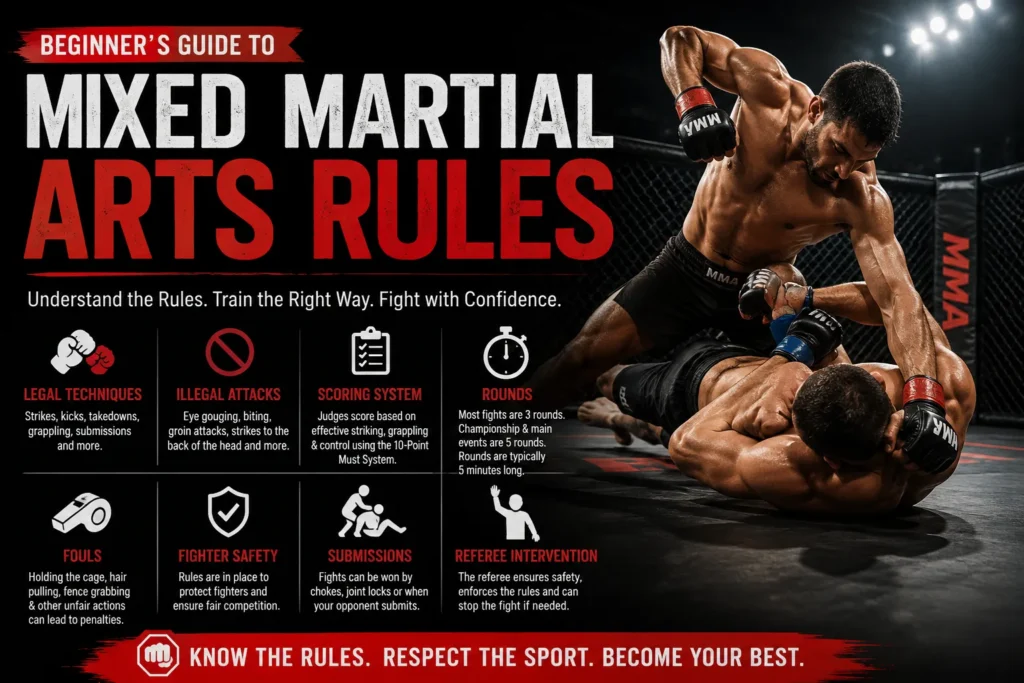
Mixed Martial Arts Rules of an amateur fight typically control legal fighting methods, banned strikes, fighter safety, scoring, rounds and referee intervention. There are a handful of different versions of Unified Rules of MMA, but these rules are typically used in major professional events.
Typically, an MMA fight is held in a closed fighting area, also known as a cage or octagon. The fights are played in predetermined rounds, usually three or five rounds for the professional fights. The rounds are typically 5 minutes in length and followed by a 1 minute break.
The referee may discontinue a fight if a fighter cannot defend themselves intelligently, submits, falls unconscious or has sustained an injury for which continuing is not safe.
what are the legal techniques Under Mixed Martial Arts Rules?
There are legal techniques under Mixed Martial Arts Rules.
A crucial aspect of MMA is the blending of a number of fighting styles. Generally, fighters have the following ability to use:
- Hand strikes (punches)
- Kicks
- Knees shall be subject to such restrictions as may be made.
- Elbow strikes (with restrictions in place)
- Takedowns and throws
- Wrestling techniques
- Clinching
- Ground-and-pound
- Submission techniques
- The capability to choke and joint locks
The ability to change from striking to grappling and vice versa. During the match, however, the fighters will have to stick to the rules governing the sport of mixed martial arts.
What Attacks Are Illegal according to mixed martial arts rules?
The sport of MMA does not permit all techniques due to the fact that it allows striking and grappling. Eye gouging, biting, pulling of the hair, attacks of the groin and some attacks to the back of the head or spine are prohibited.
Other wrongs may be holding the cage, reaching into an opponent’s gloves or shorts or utilizing the cage to gain an unfair advantage. Depending on the ruleset, some grounded-opponent strikes can also be limited.
The referee may be able to punish a fighter for the foul, in varying degrees (from warning and reduction of points through disqualification).
What Are the Rules for Points in MMA?
It is also important to know the Mixed Martial Arts Rules of MMA fights well before the final bell so that you can understand how the judges decide the winner of a fight when it comes to an end.
Effective striking and grappling is usually the first criteria that judges consider when scoring at MMA. Effective aggression and control can also be counted, if applicable, under the scoring criteria.
One of the accepted schemes is to give 10 points to the fighter who wins a round, and fewer points to the one who loses. The round most often occurs is a 10-9, and a 10-8 round is much more dominant.
A judges decision may include clean and effective strikes, successful takedowns, submission attempts, damaging ground attacks and good control of the round.
How Can a Fighter Win?
Under the guidelines of Mixed Martial Arts Rules, a fighter would win an MMA bout in a number of ways:
- Knockout (KO): Striking opponent making him/her unable to fight.
- Technical knockout (TKO): The referee, doctor or corner ends the contest.
- Submit: A fighter presses down/repeats the word submit.
- The winner is decided by the judges at the end of all the scheduled rounds.
- Disqualification: When an opponent commits serious/sustained fouls, they are disqualified.
- Technical decision: A fight is prematurely stopped due to conditions outlined in the rules.
- Draw: Judges decide that neither fighter wins.
What’s the Need for Mixed martial arts Rules?
Mixed Martial Arts Rules aren’t meant to take away the competitiveness of the sport; rather, they’re meant to set boundaries. MMA is still physically challenging, but there are rules to minimize unnecessary risks and create a uniform playing field for the competitors.
Rules also serve to help referees recognize fouls, judges mark rounds, coaches train fighters and provide them with a set of guidelines to follow during competition.
For the novice MMA trainee, the rules are not just a necessary part of the game, but they are just as vital to training as striking, grappling, conditioning and defensive skills.
Follow Strikehive Martial Arts Academy’s Official Instagram

Train Smart. Fight Strong.
Ready to put your knowledge of MMA into practice? Train with experienced coaches and develop your striking, grappling, conditioning and self-defence skills at StrikeHive Martial Arts Academy.
Frequently asked questions
No, some strikes and attacks are not allowed or are limited. Attacks to the eye, biting, groin attacks and some attacks to the back of the head or spine are examples of fouls.
Most professional bouts of MMA are three rounds long, and championship fights and some main event bouts are five rounds long. Typically, rounds are five minutes long, but may differ depending on the competition.
Judges score based on effectiveness on striking and grappling, usually using the 10-point must system. If a round is obviously won, a fighter will be awarded 10 points, while a fighter who loses a round will be awarded less.
Yes. MMA for beginners is taught through progression of skill learning, which will introduce striking, wrestling, grappling, conditioning and preventative skills. Techniques should be taught in a progressive way by a qualified coach, with emphasis on good safety practices.